We’re in a weird new world. For the first time, college basketball players can earn professional-level money without going pro.“The top NIL earners in men’s basketball are making $3-5 million per year. AJ Dybantsa reportedly earned $7M+ at BYU this past season.” Every spring now, the same question plays out across the country for top players: should I go to the NBA, or should I stay and get paid?
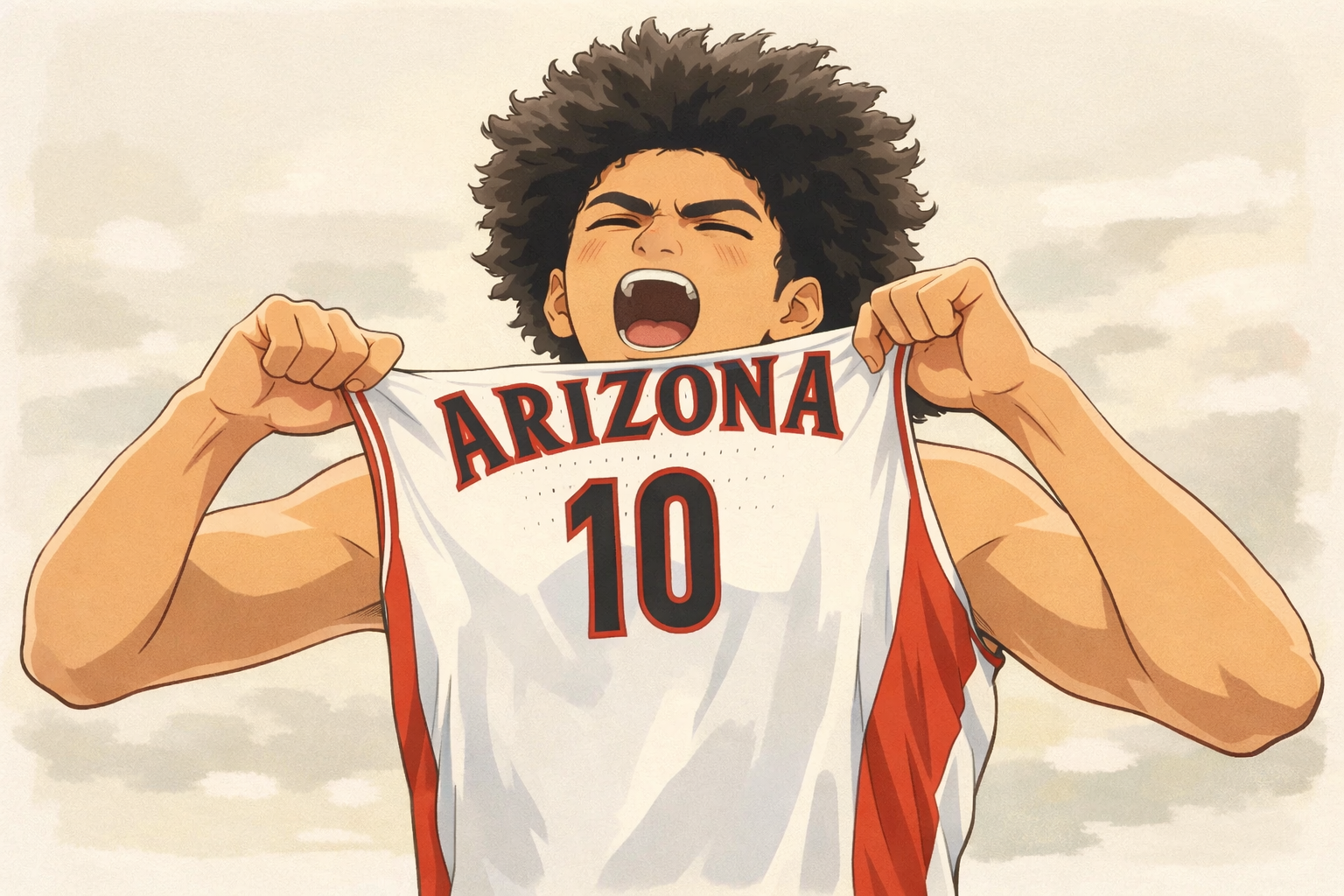
The prospect of your guys going to league (or worse, entering the portal and playing for the competition) weighs heavy after every season ends. At Arizona, Koa Peat, our freshman power forward who just led us to the Final Four, is projected around #20 in a historically loaded 2026 draft class.
My friends and I would love nothing more than for him to come back next year. But if I were him I would be making the best overall financial decision for myself and for my family. So instead of just hoping, I decided to figure out what it would actually take for it to make financial sense for Koa to stay.
The Rookie Deal
First-round picks sign four-year contracts on a fixed scale.“Years 1-2 are fully guaranteed. Years 3-4 are team options. Teams almost always sign at 120% of the scale minimum. About 89% of first-round picks have their options exercised. Source: NBA CBA, Hoops Rumors.” Here’s what the full four-year deals look like, broken out by what’s guaranteed and what’s a team option:
The first thing to notice is how steep the curve is at the top and how flat it is at the bottom. The difference between pick 1 and pick 5 is $21 million. The difference between pick 20 and pick 30 is $3.6 million. If you’re projected in the back half of the first round, your draft slot doesn’t change your rookie deal that much.
The Second Contract
The second contract matters more than the first.“Arizona has two examples of this: Aaron Gordon (#4, 2014) developed his shot, signed an $80M extension, won a championship, career earnings $170M+. Derrick Williams (#2, 2011) never found a meaningful NBA role, bounced across seven teams, career earnings ~$25M. Same school, similar profiles, $145M gap.”
- Higher picks are more likely to earn one.
- The ones they earn are much larger.
Does Draft Position Actually Matter?
On average, top picks have far more valuable careers. But most of that isn’t caused by draft position. Better players get drafted higher AND earn more, because they’re better players.“Staw & Hoang (1995) found a causal effect: teams give higher picks more playing time and longer leashes, even after controlling for on-court performance.”
Koa Peat is the same player whether he’s picked #5 or #20. His talent doesn’t change. But higher picks do get real advantages: they start from day one, they get kept around longer when they struggle, and they land on worse teams with more minutes and cap space for extensions. The effect is real but modest. Moving up a few spots doesn’t transform a career.
Does the Draft Class Matter?
This is where Peat’s situation gets interesting, and where the framework matters for any player stuck in the middle of a loaded class.
The 2026 draft is loaded. It’s the deepest since 2003.“Dybantsa, Peterson, Boozer, Ament, Brown at the top, four point guards in the lottery. Sources: ESPN 2026 Big Board, Tankathon.” Peat, a physical forward without a reliable three-point shot, gets squeezed into the #15-25 range by class depth when in average years he would go much higher.
The 2027 draft is projected as historically weak. ESPN’s Jonathan Givony reports that executives are “ringing alarm bells.” A veteran evaluator said the incoming class might not produce a single All-Star.“Sources: ESPN, CBS Sports.” CBS Sports projects that if Peat returns, he could be in contention for a top-3 pick.
Same player, two very different draft pools. In 2026, he’s the 20th-best prospect. In 2027, he might be the 3rd-best. The question is whether that shift is worth the cost of waiting a year.
Run the Numbers
Here’s the model. Adjust the assumptions and see how the math changes.“The model accounts for taxes, agent fees, time value of money (5% discount rate), injury risk (5%), and a conservative age penalty (~3% on second contract earnings). Full methodology and source code: GitHub.”
So Should Koa Stay?
Yes.
Peat is currently an ~#20 pick. If he comes back and has a good sophomore year in that weak 2027 class, I think he could go #10 or higher. Arizona could pay him ~$2 million in NIL. I’d put the odds of him actually making that jump at over 20%.
With those numbers, it’s roughly a wash at the high end of career outcomes. In the downside scenarios (stock drops, mediocre sophomore year), the NIL money and the guaranteed rookie contract from a higher pick in a weaker class still cushion the fall. Staying isn’t risk-free, but the floor is higher than most people assume.
And none of this accounts for what another year in Tucson is worth. He led us to our first Final Four in 25 years as a freshman. If he comes back, Arizona is a national title contender.
He should stay. Bear Down.
Sources: Rookie scale from the NBA CBA / Hoops Rumors. Extension rates from Hoops Rumors extension recaps (2019-2025). Career earnings from Samford Sports Analytics. Causal framework from Staw & Hoang (1995), Camerer & Weber (1999). Draft projections from ESPN, The Athletic, CBS Sports, Tankathon. Academic context from Arel & Tomas (2012), McDaniel, Meehan & Stephenson (2025). Full model and data: GitHub.